What to Expect
This is a traditional Shotokan karate school. It is important that we maintain the cultural aspects of karate, both in the way we train and in the way we conduct ourselves in the dojo.
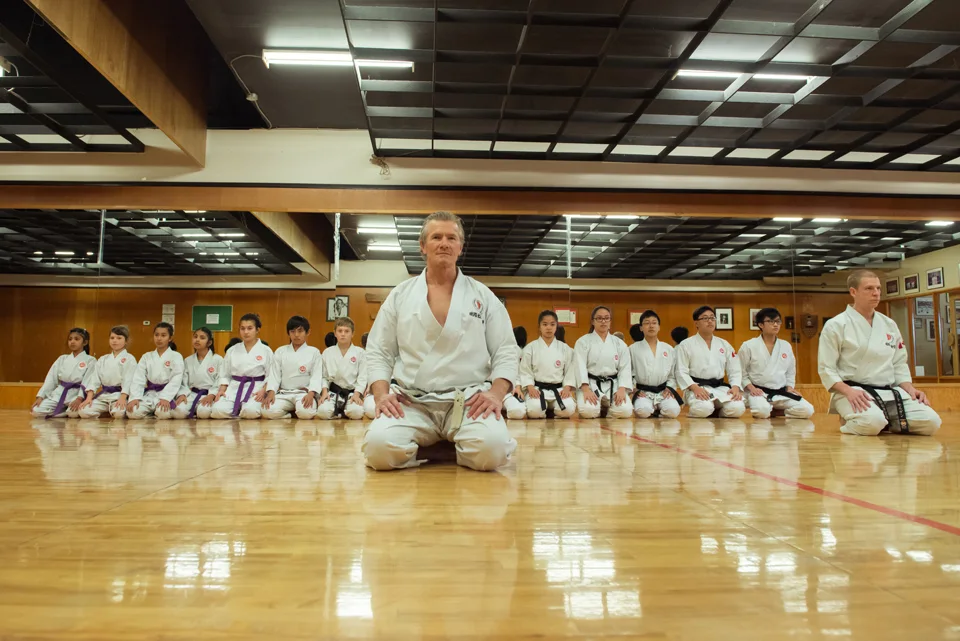
Karate is definitely not a crash course in self defense technique. Several of the people you will train with have ten, maybe even twenty years of experience, and yet they continue to learn and refine their technique. When you first begin, you will learn the fundamentals of karate movement, commonly referred to as kihon, or basics. A foundation of good basics generally leads to doing great karate.
The first ten minutes or so of every class is committed to warm up and stretching. You are advised to take advantage of this to increase your flexibility and reduce your chances of muscle and joint injury. We are fortunate to have a large number of black belts training at our club, whose responsibility is to set an example of good karate spirit and attitude. If you have any questions about dojo protocol, do not be shy to ask any of them outside of class.
Kihon, the basics
A good method of learning a new skill is to break it down into basic elements, then build on them toward more difficult components. Just as one would not calculate a complicated math problem without first learning the basics of mathematics, the body cannot perform complex moves without first mastering the fundamentals. All advanced techniques in karate are a combination or derivative of the basic moves and body principles. One must always practice basics, no matter what level of proficiency they achieve.
Kata, the forms
A kata is a predetermined set of movements representing the motions of blocking, striking, punching and kicking against imaginary opponents. As one practices these movements, the wealth of information within the kata gradually reveals itself. The longer a form is practiced, the more possibilities are understood. The key to learning karate as a self defense system lies in the mastery of kata.
Kumite, partner training
Partner training teaches the student distance and timing. It is the first real opportunity to train with a moving, thinking person, and it builds confidence in applying the basics and the moves practiced in kata. The natural progression in karate takes us from basics to kata to kumite, and then to free sparring. Each step is important. All too often, to the eventual detriment of the student, the basics and kata are ignored in favour of free sparring.
Free sparring, or jiyu kumite, gives the karate-ka the chance to test their defensive and offensive techniques under real pressure that still falls short of a true confrontation.
Etiquette and respect
There is absolutely no religious or subservient significance in bowing. It is simply a tradition and custom of Japanese karate, and should be viewed as a demonstration of mutual respect for the art and courtesy to one another. Each class opens and closes with a short, formal sequence led by the senior student, including a period of mokuso, or quiet meditation, and the recital of the Dojo Kun.
Come and try a class
New members are always welcome. Reserve a beginner session and step onto the mat, no commitment.
Reserve a class